How Exceptionally Hot is 2026 in the UK?
Examination of the longstanding Central England Temperature (CET) record suggests summer 2026, whilst the hottest to date, may not be exceptional (meaning once in 50-100 years) under the current climate regime. Hotter summers are to be expected and this will become more likely as anthropogenic global warming continues. Similarly 2026 is likely to be the hottest year so far in the CET, but this record is unlikely to stand for long. How long these records hold depends on whether a different (rather than just hotter) climate regime affects the UK.
Let’s look first at summer 2026, then the prospects for 2026 as a whole. I’ll then mull over what is actually happening to the (southern) UK climate.
Summer 2026: the hottest in the CET – by far
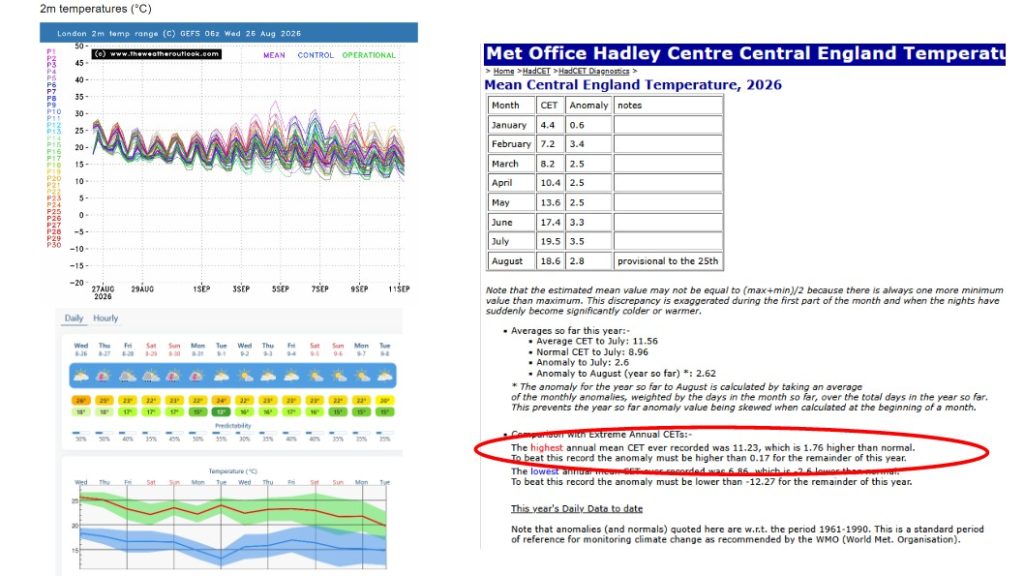
Whilst there is some excitement hereabouts that water is now occasionally falling from the sky, no heatwave or exceptionally cold weather is expected before the end of August, and indeed into September (Fig 1, left). It looks like the mean CET for August will therefore end up around 18.5C, maybe a little less (Fig 1, right).
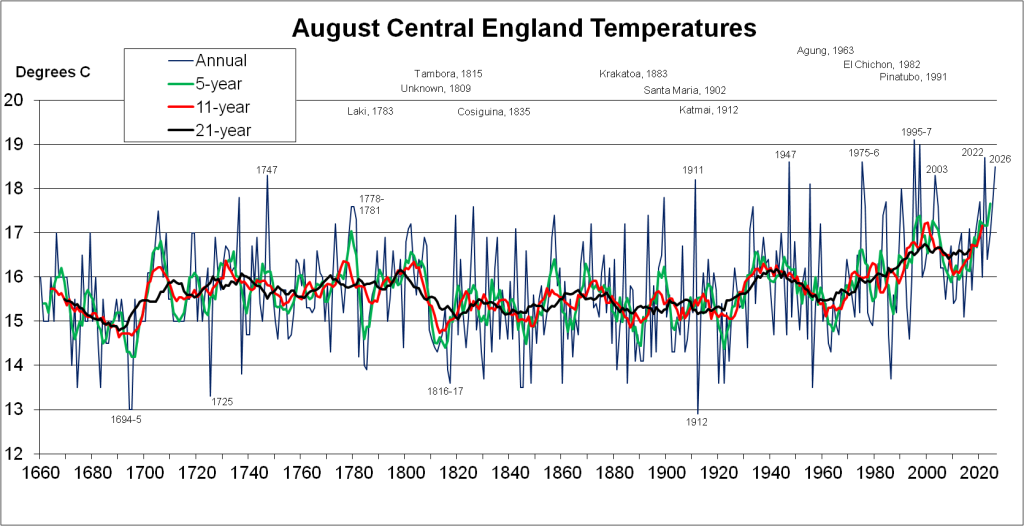
August 2026 has thus been hot, but not exceptional, at least for the late 20th to 21st centuries (Fig 2, where the 2026 figure is shown at an estimated 18.5C). Of course, before that such temperatures were rare. For example, no August mean CET exceeded 18C between 1747 and 1911!
This gives a tentative mean CET for summer (June-August) 2026 also of 18.5C:
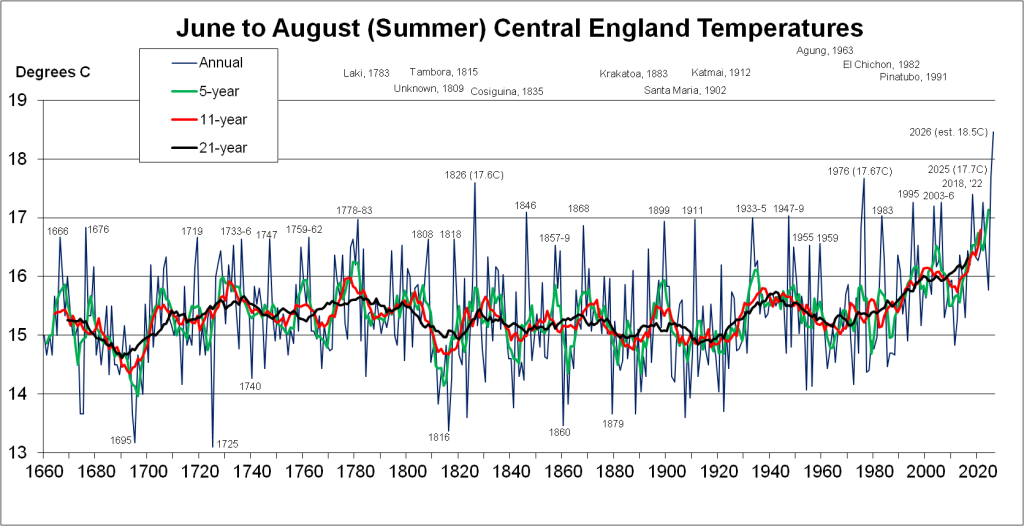
This makes 2026 the hottest summer on record by an incredible 0.8C over 2025 and 1976!
So why do I hesitate to declare 2026 an exceptionally hot summer?
First, in Fig 3 we can see that although summer 2026 was 0.8C or so hotter than summer 1976, the average summer (red and black lines) is over a degree hotter now. And the running means are not up to date – the average summer from 2016-2036, centred on 2026 may be even hotter, because of continued global warming, than the latest points on the graph in Fig 3.
Second, no single month in 2026 was the hottest on record. Here’s May in Fig 4, below, not previously published, though see also my post Maybe May Be Too Darn Hot!
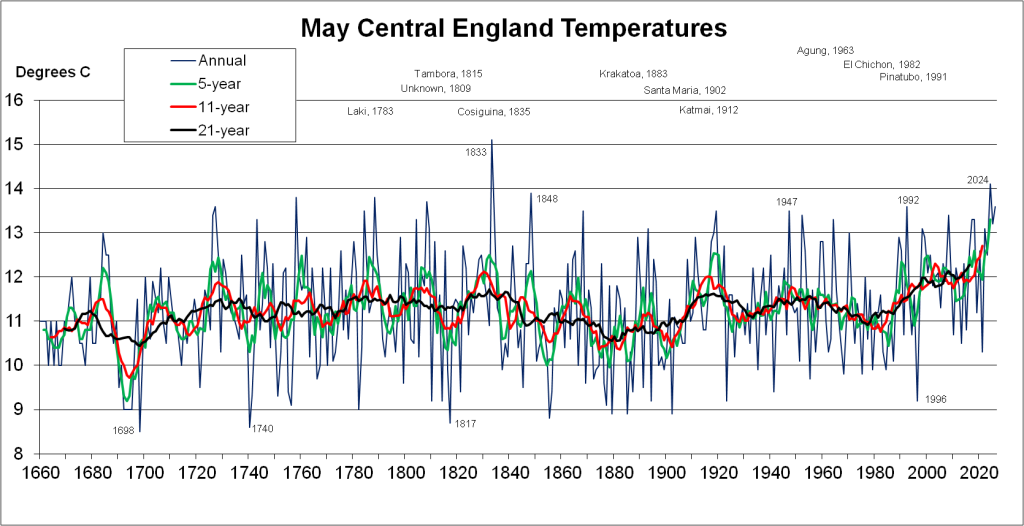
There have been several hotter Mays than 2026, including 2024 and the astonishing 1833, a degree hotter than any other May.
My post 1846 and All That – Was June 2026 Really the Hottest Ever in England? showed that June 2026 was not as hot as June 1846 and in How Bad is the UK Heatwave Problem? Part 2: A Changing Climate Regime? we saw that July 2026 was not as hot as July 2006. August is in Fig 2, above.
The fact that no single month was the hottest on record suggests to me that, whilst extreme by historical standards, none of the 2026 heat-waves in the UK were particularly long-lasting. I intend to look at this in a little more detail in a subsequent post.
Third, we can tentatively compare what happened in France in 2026 with the UK. In France June 2026 was the hottest on record. July 2026 was the hottest month ever recorded, beating August 2003 (narrowly I understand, suggesting that – given 23 years more of global warming – 2003 was more exceptional in France than 2026).
So a hypothesis might be that compared to 1976 (and, as suggested by Fig 4, 1826 as well) the UK has escaped the worst of a hot west European summer. Something more extreme may be possible.
2026 will most likely be the hottest in the CET – by far
Fig 5, below, shows the mean CET from January through August, with August 2026 estimated at 18.5C, as discussed above.
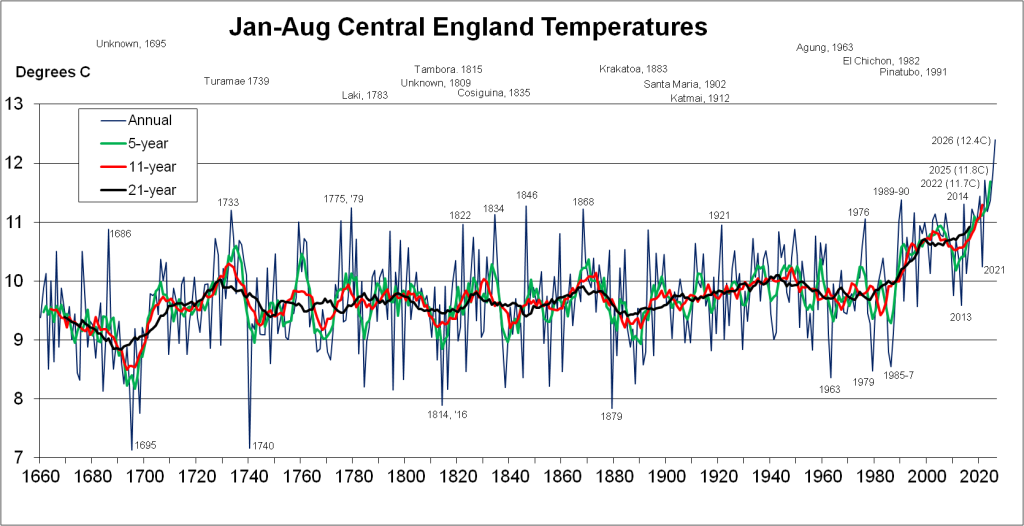
For this period 2026 is the hottest year in the CET by the huge margin of 0.6C, from last year 2025!
Possibly more scientific are the annual mean temperatures. To produce the graph in Fig 6, below, I’ve extrapolated by taking last year’s temperatures for the rest of 2026 (i.e. September to December).
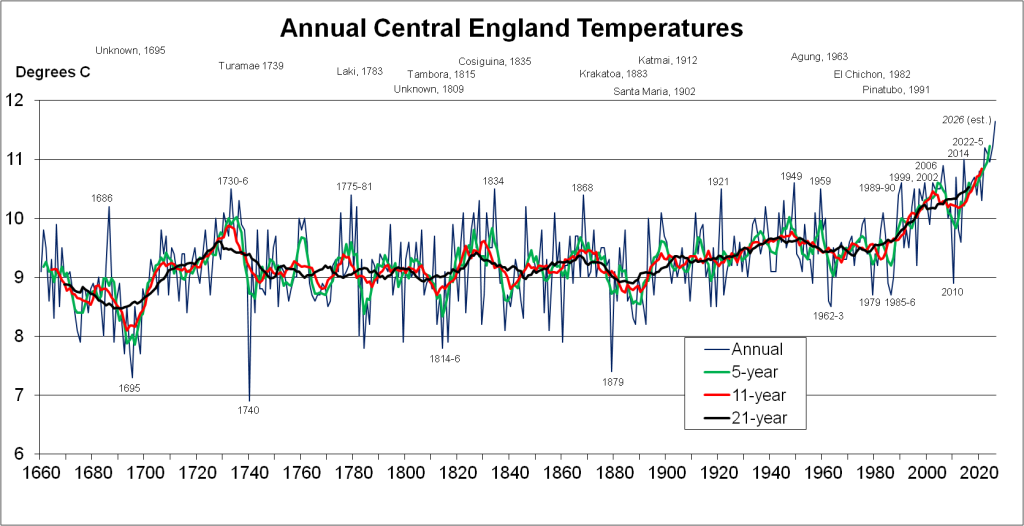
Fig 6 Mean annual CET graph, created by Tim Joslin from Met Office data
It’s not a done deal by any means, but 2026 is likely to be the hottest year on record by a significant margin. Another way to look at this is to consider the Met Office CET data on the rhs of Fig 1. They note:
The highest annual mean CET ever recorded was 11.23, which is 1.76 higher than normal.
To beat this record the anomaly must be higher than 0.17 for the remainder of this year.
Nearly every month these days is warmer than the baseline (1961-90), so with 4 months to go we’d need an unusually cold autumn and early winter for 2026 not to be the hottest year on record. And with El Nino in play that’s not expected to happen.
There are quite a few points to note about Fig 6.
What is most astonishing is that every year since 2022 – 5 years including 2026 (with the cold autumn proviso) – has been hotter than any year before 2014.
Global warming has dominated natural variability since around 1990, when temperatures in the 1730s were first exceeded (though the 1940s came close).
When will we see a hotter summer than 2026?
This is the big question. It all depends what is going on.
Here’s one more graph (Fig 7, below). The green line at the bottom is the point. It shows the deviation from the 21 year mean of each summer (June-August) in the CET. I’ve extrapolated the 21-year mean after that for 2006-26 as increasing by 0.02C per year because of global warming, which is approximately what it’s done over the last 50 years.
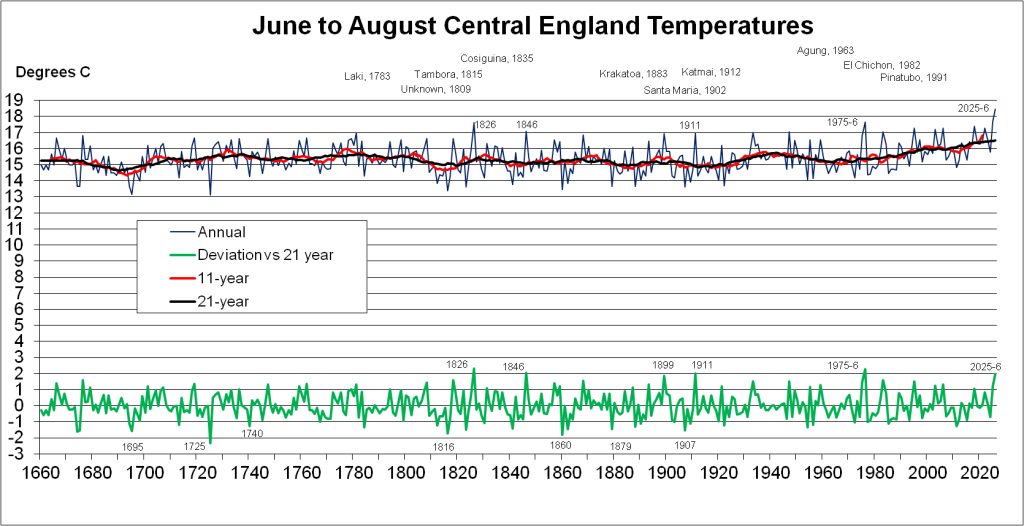
I first produced this sort of graph for my post UK Heatwaves: What are the Global Warming Risks? (1) A Really Freak Summer back in 2018. I have to say this one doesn’t back up my gut feel. 2026 is up there with the most freakish summers, at (provisionally) 1.96C above the average summers of the era (in this case 2016 to 2036). It’s exceeded only by 1826 (2.32C above), 1976 (with a 2.29C anomaly), 1846 (2.06C) and 1911 (2.02C).
Of course, this is a rough and ready measure. Major volcanic action over the next decade (as in the 1690s or 1810s) would reduce the mean summer temperatures over the next 10 years and make 2026 more anomalous for the era. Still, it’s the best I can do on the back of this envelope.
So why am I uneasy in saying that summer 2026 has been a once in ~50 years event? (Though comparable summers will become ever more likely as we recklessly continue to cook the planet).
First, we’ve had notable heatwaves and hot months many times over the past decade. I’ve been blogging on the topic since 2016.
Second, more expert (and professional!) global warming scientists tell us that the UK (especially the south, i.e. England, the area I’m homing in on) will experience hotter, drier summers as the planet heats up. I see no reason to doubt them.
Third, summer temperatures are amplified, rising faster than average global warming. I suggested one reason why this might happen at mid (and indeed high) latitudes in my post Heatwave Horror back in 2022. Another is that there is a feedback as drought conditions arise early in the summer. The less moisture there is to evaporate from soils, plants and bodies of water the higher the air pressure – “heat domes” can therefore be expected to become more persistent at higher temperatures.
So, not only might my extrapolation for Fig 7 prove to be too conservative (i.e. summers might warm faster), but a truly exceptional summer would therefore be expected to begin early (May, say) and persist into September. A version of Fig 7 for May to September might be interesting (when I produce this provisionally 2026 is indeed “only” a once in ~20 years event; since I get something similar for July-August perhaps “meteorological summer” is misleading in this case).
But a real assessment of the risk of more summers like 2026 requires analysis of exactly what is going on.
Of course we have continuing global warming, so the risk can only increase.
On top of that industrial pollution has masked global warming – as I touched on briefly back in May – and is still unwinding. This suggests we’re in a period of more rapid global warming.
According to an article in New Scientist (paywall), climate models may have underestimated global warming, but I’m not relying on modelling – rather I’m trying to extrapolate from empirical data.
On the other hand, on top of global warming, we’re experiencing a lull in volcanic activity (I’ve noted some significant events on the graphs in Figs 2, 3, 5, 6 and 7). A repeat of the eruptions of the 1690s or 1810s or even Pinatubo in 1991 would certainly result in a drop in at least the rate of warming for a few years, although this could simply lull us into a false sense of security.
But all this may be too much of a simplification. It could be that warming changes weather patterns, by affecting sea surface temperatures in different ways, as New Scientist reports (paywall). Not only might large-scale global currents (such as the AMOC, aka the “Gulf stream”) weaken, this could be exacerbated by meltwater from Greenland. This could lead to more heatwaves in Europe and the UK.
There’s a lot to process, but for me the most consequential – and astonishing – consequence of global warming in the UK is the rapidly increasing maximum temperatures. These are both reflected in the longer-term (e.g. monthly) temperature data and exacerbate the heat by increasing the likelihood of drought conditions developing.
In conclusion, I’ll be surprised (and relieved) if (measured by the CET) a hotter UK summer than 2026 doesn’t occur before 2040. And it could come sooner (though probably not in 2027). Watch this space!