How Bad is the UK Heatwave Problem? Part 2: A Changing Climate Regime?
Is the hot, dry summer of 2026 a once in a half-century event, like 1976 but hotter because of global warming, or is it indicative of a change in climate patterns in a warmer world? Examination of the 1659-2026 Central England Temperature (CET) record suggests there is still some scope for more severe summers under the current climate regime. I hypothesise that we are seeing an approximately once a decade rather than once a century summer during a climate phase including hotter, drier summers, superimposed on a warming trend, itself seeing something of a spurt! Such phases may – again tentatively – be more frequent in a warmer world.
Let’s consider how exceptional summer 2026 might be under the current climate regime.
By “climate regime” I mean the typical weather patterns in a region, for example the timing of rainy seasons or contrast between the seasons. In this case the question is whether the UK can expect something similar to its historic mish-mash of weather in the future, just warmer, or whether we might experience more disproportionately hotter, drier summers. Quite an important question.
Why might we think weather patterns would change?
Well, here’s an interesting graph:
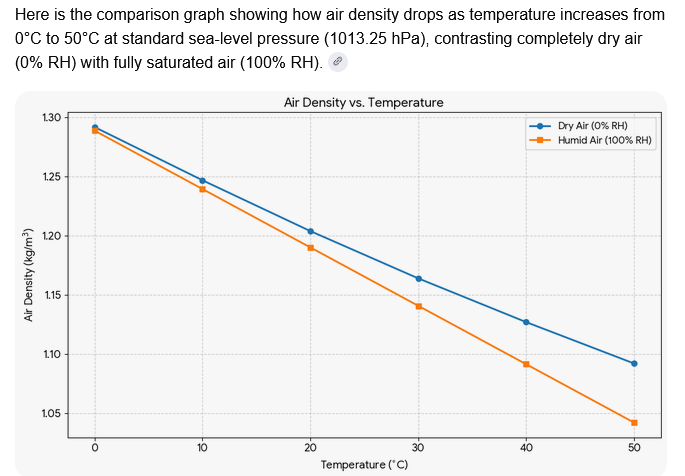
The point, of course, is that our weather is driven in part by air-masses of different density. And air density principally depends on temperature and humidity. The hotter it is, the less dense air is, but dry air, in, say, a desert region, is more dense than humid air at the same temperature.
Fig 1 shows that the effect of humidity becomes more important at higher temperatures. For example, reading from the graph, to be as light as 100% humid air at 30C, totally dry air would have to be at an average temperature of ~36C, whereas if the humid air is only at 20C, the dry air only needs to be at ~23C.
To cut to the chase, this means that we might expect it to become more difficult in a warmer world to shift dry (high pressure) air masses.
There’s reason to suppose weather patterns would change in a warmer world.
In Part 1 I listed some of the heatwaves in my part of the world – the UK, specifically southern England – in recent years. We can also use monthly mean temperatures as a proxy for heatwaves, at least in the summer months. Do these suggest 2026 is a freak year or that hot summers are becoming more common? (Of course, both could be true!).
A month ago I tetchily pointed out that June 2026 wasn’t the hottest June on record in the long-running Central England Temperature (CET) record – it wasn’t as hot as June 1846. Guess what? July 2026 was also “only” the second hottest July, although this time no-one claimed otherwise, since the hottest was recent enough (2006, when I remember being very uncomfortable in Cambridge) to be “since comparable records began” (I argue that we need to look as far back as possible if we want to really understand what’s going on). Here’s the graph of mean CETs for July, as always since 1659:
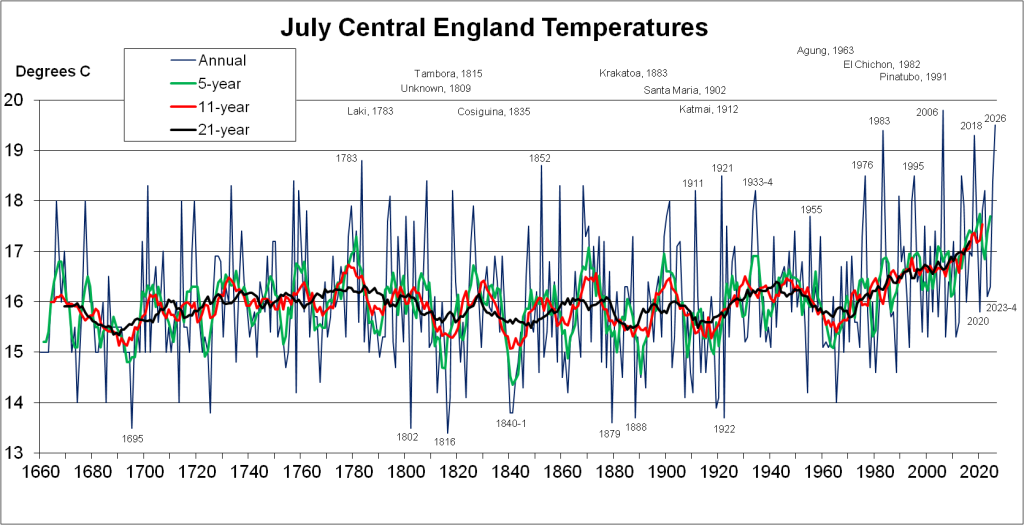
Is July 2026 an anomalous spike above the 21-year and 11-year running mean temperature for July? No it isn’t. 2006 was, as was 1983, when, coincidentally I was also in Cambridge, suffering much less in a fine old cool student house. I do remember playing a lot of tennis that summer, though!
What about June and July? After all, the average for one month is contingent on the exact dates of heat spikes (sometimes called “Spanish plumes” in the case of the UK). Here’s the graph:
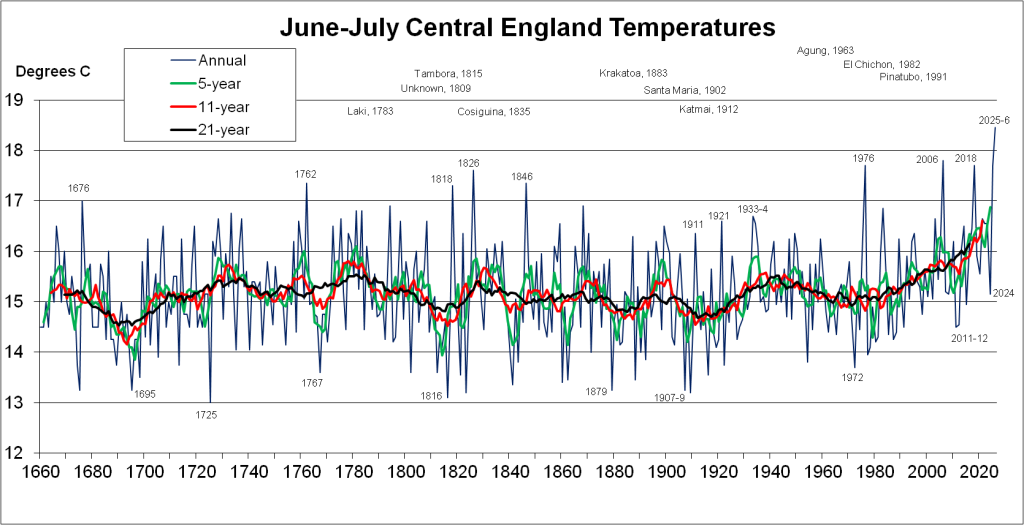
Now we’re getting somewhere! At least 2026 is the hottest year in the CET record over June and July, significantly hotter than 2006, closely followed by 1976, 2018 and then 1826. But is it as freakish as 1976? It depends a little on where the 11-year and 21-year running means end up, but the short answer is no. June and July 1976, for example, were on average nearly 3C (2.87C to be precise) hotter than the mean for years 1971-1981 (including 1976 itself), whereas 2026 has been only just over 2C warmer than the mean for 2016-2026. The more relevant 11-year mean, 2021-2031 will most likely be higher.
I think this is bad news, I’m afraid.
My suggestion is that summer 2026 is a (very approximately!) once a decade event, rather than a once in 50-100 years event, like 1976, 1911 or 1946, in the current climate regime.
To further illustrate the point, here’s one of my favourite graphs:
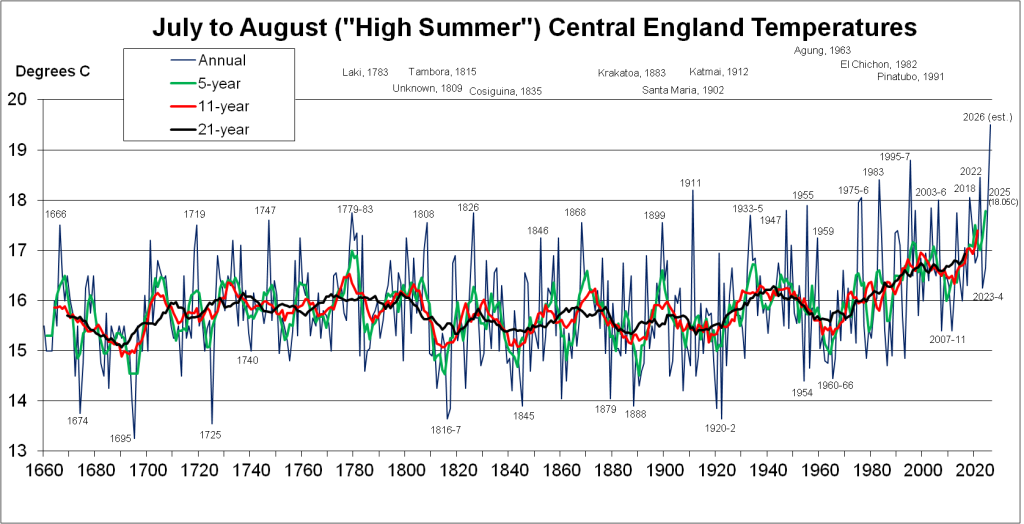
What stands out to me (though not quite so much now I’ve extended the scale!) is the spike for 1911, which is 2.73C higher than the 21-year mean. Even if August 2026 comes in at 19.5C, the same as July, as I’ve notionally put in Fig 4, the “High Summer” mean CET will still be “only” 2.56C above the 21-year mean centred on 2016 (the latest available, obviously), and only 2.1C above the 11-year mean centred on 2021. At the time of writing, August 2026 is running at 18.9C:
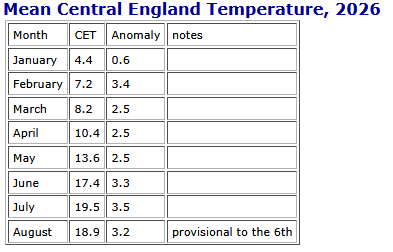
Whilst a further heatwave is expected in the next week, such high daily mean temperatures become less likely as we approach the end of August.
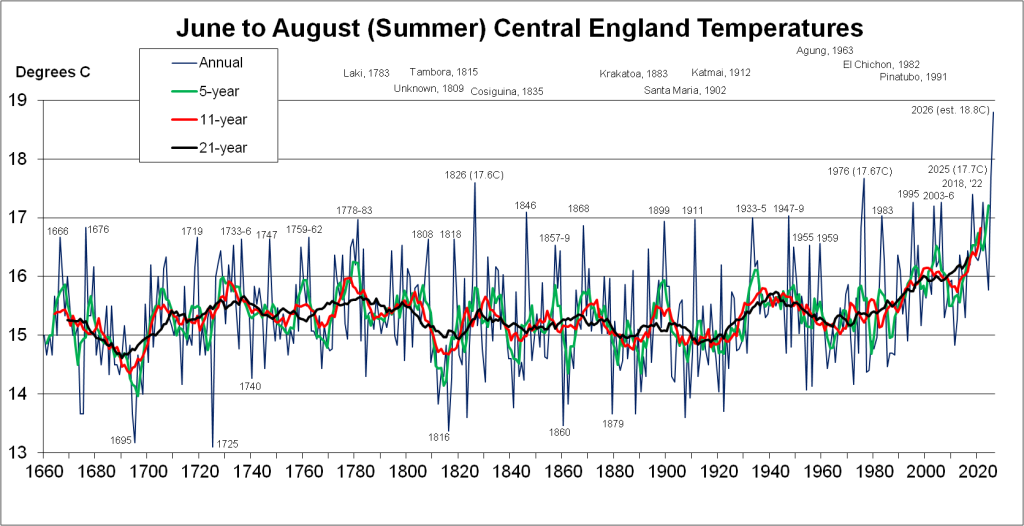
For the whole summer it’s closer – only in our hypothetical high case of a 19.5C mean for August (0.4C hotter than the August record set in 1995) does 2026 approach the freakishness of 1976 and 2016:
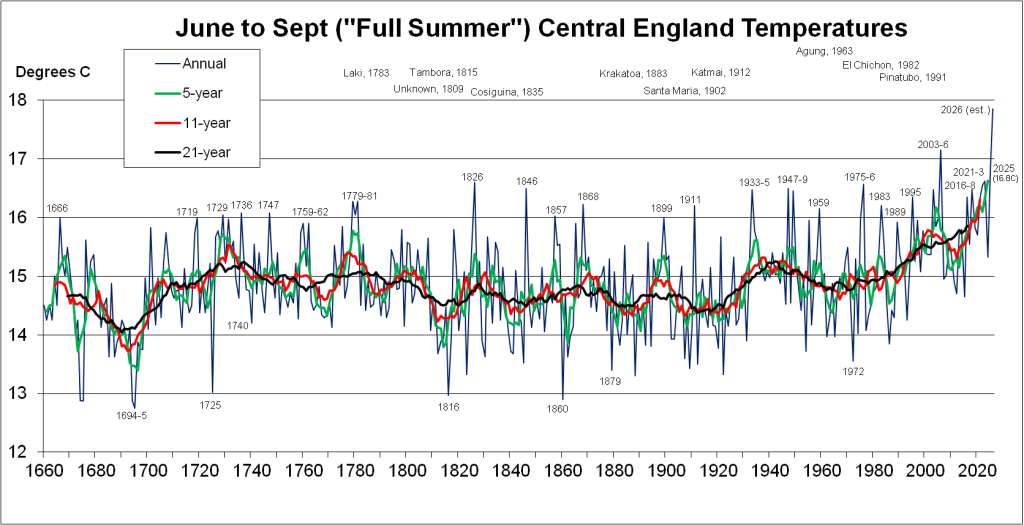
The most memorable summers extend into September and similar heroic assumptions (19.5C for August and 15C for September – any more and I’d have had the hassle of extending the y-axis!) are necessary for 2026 to be comparably anomalous to 1846, 1826, 1911 and 1976:
For completeness and in acknowledgement of the May 2026 heatwave, I’ve also brought up to date my graph of “Long Summer” (May-September) CETs:
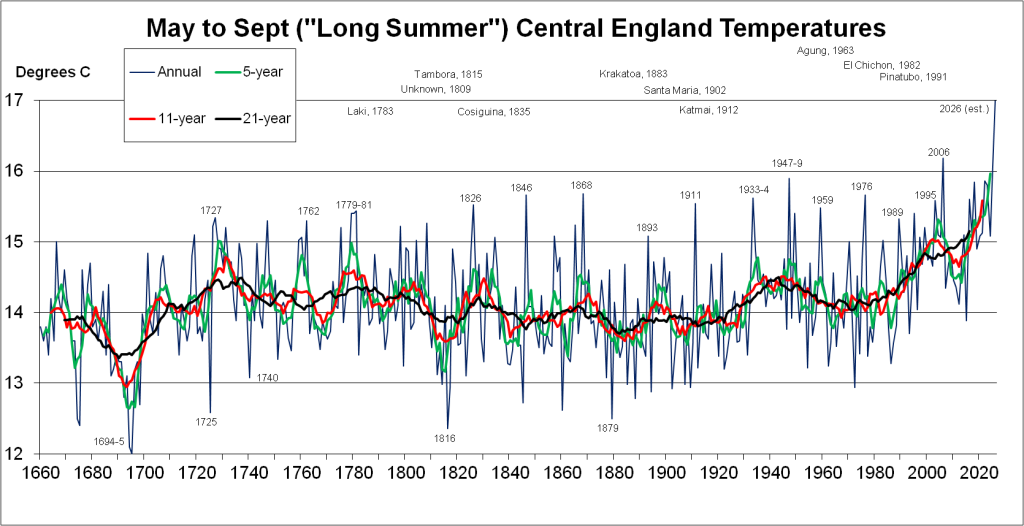
Once again, even under my fairly heroic assumptions (the same as for Fig 7), 2026 is not incredibly exceptional, partly because some of the other famously hot summers (e.g. 1947 and 1976) also had warm Mays, including some notable heatwaves.
Of course, if late August and September 2026 do turn out to be exceptionally hot I will have to revise my opinion. Watch this space!
Also, if temperatures take a (temporary) turn downwards during the next few years due to a period of increased sulphurous volcanic activity, such as occurred most notably in the 1690s and 1810s (see Figs. 2, 3, 4, 6, 7 and 8!), then 2026 will stand out more in the climate record as an exceptional summer.
So, as well as global warming, it may well be that we are experiencing not a freak year, but a periodic spell of hotter summers as occurred famously in the 1730s and many other times since, for example, in the mid 1930s, the late 1940s, the mid 1970s – which did include a freak summer – the late 1990s and the mid 2000s.
Global warming is just making 2026 seem like a freak summer.
I wrote in 2022 (when I ranked all the “High Summers”, Meteorological Summers” and “Full Summers” up to that year), that “there’s plenty of scope for a summer hotter than that in 2022, even without further global warming.” This was evidently correct, but I think there’s still some scope for a summer hotter than 2026 in the CET region under the current climate regime.
Note I’m not commenting on whether this is true for the rest of Europe, or Europe in general. A hotter summer in the UK could clearly result from more of the pulses of hot air that have characterised summer 2026 (and to a lesser extent 2025) wafting towards these shores rather than moving towards the east of the region.
I haven’t developed the idea I illustrated in Fig 1 as much as I wanted to (another time perhaps). By intensifying the air density contrast between dry regions (deserts and most land areas) and wet regions (oceans and rainforests), it is certainly plausible that (on top of the actual general warming) global warming has increased the likelihood of climate patterns that create hot UK summers – and bumps in the CET record. But this is just a hypothesis at this stage.